Recently Uploaded Works

![Obey]()
Jérôme Mesnager Obey
Collaborative work by Jérôme Mesnager and Lasveguix This collaborative work brings together two emblematic figures of Parisian street art: Jérôme Mesnager, creator of the mythical "Homme Blanc" (White Man) since 1983, and Lasveguix, an artist known for his poster and urban collage work. Their encounter gives birth to a hybrid piece where two distinct but complementary visual universes converse. Visual Description At the center of the composition emerges a stylized female portrait, a recognizable signature of Mesnager in his more recent vein: a refined face, rendered in black and white flat areas, framed by hair adorned with stylized blue foliage evoking a vegetal crown or a floral mantilla. The frontal and intense gaze immediately captures attention. The figure wears a black outfit with white graphic motifs, treated as a modern icon — somewhere between a Madonna, a Frida Kahlo, and a pop heroine. Around this portrait, Lasveguix deploys his language of decollage and tearing: layers of torn papers, superimposed poster fragments, shreds of typography ("LAS VE GUIX", "time", "he world", "OBEY"), bursts of vibrant colors (dominant solar yellow, blues, touches of red and green) that emerge through the tears. The background features a black and white typographic pattern reminiscent of Shepard Fairey's famous OBEY logo, reinterpreted here as a repetitive background motif. Interpretation of the Work The tension of the piece arises from the contrast between the figure and her environment: Mesnager's woman, serene and iconic, seems to emerge — or resist — the visual chaos of the street that surrounds her. Lasveguix's torn elements tell the story of the memory of the urban wall, those successive layers of posters, covered, torn, which constitute the wild archaeology of the city. The title "Obey" adds a critical dimension: reappropriating the iconic slogan of street culture, it questions submission and injunction here — who obeys? To what? The direct gaze of the female figure, far from being docile, seems instead to oppose an assertive presence to the typographic order that seeks to impose itself.
€600,00
-
![BASQUIAT X WARHOL]()
Jérôme Mesnager BASQUIAT X WARHOL
Collaborative work by Jérôme Mesnager and Lasveguix A mythical encounter revisited Basquiat x Warhol celebrates one of the most legendary collaborations in the history of contemporary art — the one that united, in the effervescent New York of the 1980s, Pop Art Pope Andy Warhol with neo-expressionist prodigy Jean-Michel Basquiat. Jérôme Mesnager and Lasveguix extend this mythical dialogue through their own artistic encounter, echoing the spirit of creative brotherhood that linked the two American icons. The art of the torn poster Lasveguix here deploys the full richness of his visual vocabulary, directly inherited from the poster artists — Villeglé, Hains, Rotella — who made urban tearing a fully-fledged artistic gesture. Layers of paper overlap, tear, and reveal themselves: a poster for Andy Warhol's Exploding Plastic Inevitable (the legendary Velvet Underground multimedia happening) sits at the top left, while iconic portraits of Warhol and Basquiat — taken from the famous photographs of their promotional boxing duo from 1985 — emerge from the colorful chaos. Pink splashes, yellow and red flat areas, and typographical fragments compose a visual symphony that evokes the murmur of New York walls, saturated with images and memories. Mesnager's luminous signature At the heart of the composition, Jérôme Mesnager's intervention is immediately recognizable: his Homme en blanc (Man in White), a universal and luminous silhouette created in 1983, asserts itself in a dynamic, almost moving posture. This emblematic character, whom the artist has scattered on walls all over the world — from Ménilmontant to the Great Wall of China — here becomes the link between the two American masters. A symbol of peace, strength, and light, the Man in White dialogues with the ghosts of Warhol and Basquiat, as if Paris were extending a hand to New York across the decades. A conversation between schools The work creates a fascinating double lineage: it inscribes French street art (Mesnager is one of its historical pioneers) in the continuity of the New York energy of the 80s, while reinterpreting the spirit of new realism through Lasveguix's contemporary approach. There are also nods to pop culture (a Darth Vader silhouette at the bottom left), the date "AUGUST 2023" which anchors the piece in its era, and the crossed signatures of the two artists that seal this collaboration. A vibrant homage Basquiat x Warhol is not a simple nostalgic citation: it is a mise en abyme of creative friendship, a bridge thrown between generations and continents. Mesnager and Lasveguix pay homage to two tutelary figures while asserting their own language — proof that urban art remains a living ground for dialogue, where icons are passed on like torches.
€600,00
-
![Smile of Frida]()
Wawapod Smile of Frida
Collaborative work by Lasveguix and Wawapod This mixed-media work on canvas embodies the explosive encounter between two complementary urban universes, celebrating the iconic figure of Frida Kahlo through the lens of street art and pop culture. Composition At the heart of the work, Frida Kahlo's portrait emerges from a pattern of white dots on a deep black background, reminiscent of pixel art aesthetics or Roy Lichtenstein's screen printing. This halftoning technique, a signature of Wawapod, transforms the face of the Mexican icon into an almost spectral apparition — one must step back for the enigmatic smile to fully reveal itself, playing with the viewer's perception. Golden cracks traverse this dark background, evoking the Japanese philosophy of kintsugi, where cracks become ornamentation. Collages and fragments The upper and lower parts unfold Lasveguix's characteristic universe: a profusion of torn collages with clean edges, layering vintage posters, retro advertisements ("Philips Autoradio", "Meet the Girls from the Bureau"), childhood figures, and pop culture references. The word "AMOUR" (LOVE) bursts forth on a "HELLO MY NAME IS" tag in the upper left, while the legendary logo of the band The Who stands out in the bottom center, a rock nod to the rebellious energy that inhabited Frida. Palette and gestures Purple splashes, pink and red drips, and the black stencil energize the whole and unify the two visual registers. This tension between typographic order and spontaneous gesture, between collective memory and intimate icon, constitutes the strength of the piece. Reading the artwork Smile of Frida dialogues with the legacy of Mimmo Rotella and poster artists, while aligning itself with the lineage of halftone portraits popularized by artists like Jef Aérosol or Dain. Frida's smile — this woman who painted pain with fierce joy — here becomes the vanishing point of a world saturated with images, slogans, and nostalgia. A vibrant tribute where two artists' signatures meet in the lower right to seal this collaboration.
€1.450,00
-
![Urban Mona Lisa]()
Lasveguix Urban Mona Lisa
Urban Mona Lisa is a work on wood by the contemporary artist Lasveguix , created from a collage of torn posters and pictorial interventions inspired by urban aesthetics, revisits one of the most famous faces in art history by immersing it in the visual energy of the street. At the center of the composition appears the famous portrait of the Mona Lisa , whose calm gaze and enigmatic smile contrast with the graphic tumult that surrounds her. The classic image seems to emerge from a wall of torn posters, as if this timeless icon had been rediscovered beneath the successive layers of a constantly transforming city. Lasveguix constructs the work from layers of torn paper, typographic fragments, vibrant colors, and splashes of paint . The tears reveal different visual layers, evoking the urban palimpsests found on the billboards of major cities. This decoupage technique creates a relief and texture that reinforce the materiality of the work. The wooden support accentuates this physical dimension and gives the composition an almost sculptural presence. The traces of paint, scratches, and overlaps contribute to a raw aesthetic, directly inspired by the language of street art. With Urban Mona Lisa , Lasveguix creates a dialogue between art history and contemporary urban culture . By placing the Mona Lisa at the heart of a fragmented and colorful visual universe, the artist transforms this classical masterpiece into a reinvented icon, captured in the visual effervescence of the city.
€990,00
-
![Gainsbourg under arrest]()
Lasveguix Gainsbourg under arrest
Gainsbourg Under Arrest is a work on wood by the contemporary artist Lasveguix , which falls within the tradition of urban Pop Art and the décollage inspired by the torn posters of major cities. At the heart of the composition appear two black and white portraits of Serge Gainsbourg , presented as police identification photographs. This visual device evokes an arrest warrant , reinforcing the provocative and rebellious image of the artist, a major figure in French culture known for his nonconformity and outspokenness. Around these portraits, Lasveguix constructs a dense visual universe composed of layers of torn posters, typographic fragments, splashes of paint, and colored textures . The tears reveal different graphic strata, like on an urban wall covered with successive posters, giving the work a raw and vibrant dimension. The presence of the word “FRAGILE” in the upper part of the composition creates an interesting contrast with Gainsbourg's image: both a provocative icon and a profoundly complex personality. This tension between fragility and insolence echoes the artist's public image. The wooden support accentuates the materiality of the work and highlights the thickness of the collage and the pictorial interventions. The paint splatters, scratches, and deliberately altered areas contribute to an aesthetic inspired by the street and the passage of time. With Gainsbourg Under Arrest , Lasveguix pays homage to a mythical figure of popular culture while reinterpreting him through the visual codes of urban art. The work transforms the icon into a fragment of cultural history , captured in an imaginary wall where memory, provocation, and artistic energy intertwine.
€990,00
-
![Marilyn Playboy]()
Lasveguix Marilyn Playboy
Marilyn Playboy is a work on wood by the contemporary artist Lasveguix , who blends the codes of Pop Art , street art and urban collage . The artist reinterprets the timeless icon Marilyn Monroe through a dense visual collage, inspired by the billboards of major cities. At the center of the composition, Marilyn appears in an iconic, glamorous pose, clad in fishnet stockings and heels, seated with provocative elegance. The black-and-white image, directly inspired by the aesthetics of vintage magazines like Playboy , contrasts sharply with the colorful chaos that surrounds her. The work is constructed from layers of torn posters, fragmented typography, and paint drips . The tears reveal different graphic layers—vibrant colors, raw textures, and fragments of advertising visuals—evoking urban walls weathered by time. This technique gives the piece a highly tactile and almost archaeological dimension, as if several cultural eras were being revealed simultaneously. The wooden support reinforces this materiality and accentuates the relief effect of the collage. The splashes of paint, the flat areas of primary colors, and the fragments of words contribute to a deliberately raw and spontaneous aesthetic. With Marilyn Playboy , Lasveguix plays with the collective fascination for popular icons. The artist subverts glamorous imagery to plunge it back into the visual energy of the street, creating a dialogue between pop culture, advertising, sensuality and urban art . This work thus embodies a contemporary vision of the Marilyn myth: a figure that is simultaneously mythologized, fragmented and reinvented through the visual codes of the city.
€990,00
-
![Urban Girl #2]()
Lasveguix Urban Girl #2
Urban Girl #2 fits into the raw and vibrant aesthetic of urban art. Made from torn and recomposed posters on a wooden support, the work superimposes typographic fragments, burst colors and traces of material to recreate the visual energy of the street. At the center of the composition appears a black and white portrait of a woman, captured in an expressive and almost cinematic pose. Her upturned gaze and jeweled hands lend the figure a sensual, mysterious, and iconic dimension. This contrast between the elegance of the portrait and the graphic chaos of the torn posters creates a strong visual tension. Around her, layers of urban posters—typography, fragments of concert announcements, and snippets of slogans—create a saturated visual landscape dominated by yellows, pinks, purples, and blacks. Tears and accumulations of paper reveal the texture of the collage and evoke the passage of time on city walls. With Urban Girl #2 , Lasveguix captures the very essence of street art: a meeting of popular culture, the punk aesthetic of torn posters, and contemporary female icons. The work transforms the visual language of the street into a powerful artistic composition, where beauty emerges from urban chaos.
€990,00
-
![Urban Wall]()
Lasveguix Urban Wall
Urban Wall of Lasveguix is an emblematic work that captures the raw and authentic essence of the street, drawing direct inspiration from urban walls marked by time, successive interventions, and layers of collective memory. The surface of the work evokes a fragment of the city torn from its context, where ripped posters, traces of paint, graffiti, and spontaneous signs are superimposed. The worn, almost eroded textures interact with vivid, contrasting colors—bright yellows, acid pinks, deep blues, and charcoal blacks—creating a visual tension between decay and vitality. The inscriptions and symbols, partially legible, reveal words, hearts, or universal signs, like fragmented messages left by anonymous individuals. Lasveguix's approach is both instinctive and controlled. Through collage, tearing, and painting, the artist constructs an urban palimpsest where each layer tells a different story. The work thus becomes a living testament to public space, its chaotic energy, and its power of free expression. With Urban Wall , Lasveguix doesn't seek to represent the city, but rather to capture its essence, its scars, and its raw poetry. The work invites the viewer's gaze to wander, to decipher its layers, and to feel the intensity of an art born in the street, deeply rooted in reality and resolutely contemporary.
€2.500,00
-
![Urban Wall Basquiat]()
Jérôme Mesnager Urban Wall Basquiat
Urban Wall Basquiat is a powerful collaborative work signed by Jérôme Mesnage and Lasveguix , who pays homage to the legacy of Jean-Michel Basquiat while asserting a style deeply rooted in contemporary urban aesthetics. The composition evokes a city wall marked by time, torn posters, and successive layers of visual interventions. Fragments of posters in shades of yellow, pink, and black, partially ripped, interact with dark areas, tags, and bursts of color, creating a dense, vibrant, and chaotic surface, true to the raw energy of the street. At the heart of the artwork appears the famous white body of Jérôme Mesnager, an emblematic figure of street art, captured in an upward and expressive movement. This luminous figure contrasts with the visual violence of the background and embodies a form of momentum, resistance, and freedom, like a human presence seeking to emerge from the urban tumult. Lasveguix's intervention reinforces the graphic and textural dimension of the whole, through a process of collage, tearing, and layering that echoes Basquiat's radical aesthetic: an instinctive, political, and profoundly vibrant style of painting. The work thus plays on the collective memory of street art, somewhere between homage, reinterpretation, and contemporary reappropriation. Urban Wall Basquiat presents itself as an urban palimpsest, where the history of graffiti, the mythology of modern art, and the raw reality of the street intersect. A committed, vibrant, and resolutely contemporary work, it celebrates the expressive power of urban art as a universal language.
€3.000,00
-
![Urban Malabar]()
Lasveguix Urban Malabar
With Urban Malabar , Lasveguix subverts the codes of advertising and popular imagery to reveal their mechanisms and excesses. The central figure, a smiling, retro-style character, seems to emerge from a pile of torn posters and graphic fragments. His deceptively reassuring expression, combined with the raised thumbs-up gesture, evokes a promise of standardized happiness, instantly recognizable yet profoundly ironic. The word "MALABAR," imposing and colorful, stands out like an advertising slogan torn from its original context. Around it, layers of torn paper, splashes of pink paint, and abraded areas convey the visual violence of urban space and the constant saturation of commercial messages. Here, collage becomes a battleground between graphic seduction and the erosion of reality. The chromatic contrasts—bright yellows, deep blacks, off-whites, and touches of pink—reinforce the immediate impact of the work while underscoring its critical nature. Behind the playful, pop aesthetic lies a reflection on consumerism, the repetition of images, and the superficiality of advertising. With this work, Lasveguix situates his art within a direct lineage of street art and pop art, transforming a familiar icon into an ambiguous symbol. Malabar acts as a jarring mirror to our image-driven society, where outward enthusiasm often masks a more fragmented and chaotic reality.
€200,00
-
![Pop skull]()
Lasveguix Pop skull
With Pop Skull , Lasveguix revisits the universal iconography of the skull through a resolutely pop and urban language. At the center of the composition emerges a stylized skull, rendered in black and white, almost screen-printed, which stands out as a figure both familiar and unsettling. Its fixed smile oscillates between irony and provocation, recalling the tenuous boundary between popular culture and contemporary memento mori. The artwork is constructed from a dense collage of torn posters, fragmented typography, logos, and media references. The vivid colors—saturated yellows, electric blues, pinks, and blacks—create a striking contrast with the monochrome skull, accentuating its visual impact. This chaotic layering evokes urban walls covered with advertisements, slogans, and ephemeral messages. The tears, torn layers, and abraded areas are integral to the narrative of the work. They reflect the wear and tear of time, the saturation of the image, and the visual violence of our contemporary environment. The skull, a timeless symbol of death, is thus confronted with the excess of signs and consumerism, becoming a pop icon emptied of its original gravity, but imbued with a new critical irony. With Pop Skull , Lasveguix offers a striking work at the crossroads of street art and pop art, where the seductive aesthetic masks a deeper reflection on mass culture, the repetition of images, and the trivialization of symbols. The work stands as a jarring mirror of our times, at once playful, violent, and profoundly contemporary.
€200,00
-
![Le Mans]()
Lasveguix Le Mans
With Le Mans , Lasveguix pays homage to an icon of cinema and automotive culture by merging street art aesthetics, urban collage, and collective memory. At the center of the composition appears the intense face of Steve McQueen, the mythical figure from the film Le Mans (1971), embodying speed, control, and a form of raw freedom associated with motor racing. The artwork is constructed from fragments of torn posters, ripped-off typography, and superimposed visual layers, evoking city walls marked by time. The tears, cracks, and erased areas create a tension between appearance and disappearance, like a memory reconstructed from traces. The race number, graphic references, and textual elements reinforce the historical and symbolic grounding of the work. The contrast between the black and white portrait and the bursts of vibrant colors—yellows, blues, greens, and reds—energizes the composition and conveys the energy of the race, the noise, the speed, and the adrenaline of the circuit. This chromatic opposition also underscores the dialogue between past and present, between a timeless icon and contemporary visual language. Through Le Mans , Lasveguix does more than simply represent a cult figure: he reinserts it into the urban space, confronting it with the ravages of time and the visual violence of the street. The work thus becomes a manifesto that is both nostalgic and modern, celebrating the legend, the mechanics, and the collective imagination linked to the mythology of speed.
€200,00
-
![Marianne Obey Road Sign #2]()
Lasveguix Marianne Obey Road Sign #2
On this authentic road sign, Lasveguix presents a new variation on his signature urban aesthetic. At the center, a female figure inspired by Obey's iconography emerges from a dense collage of poster fragments, shattered typography, and vibrant colors. The portrait's deep blue contrasts with the layers of torn paper surrounding it, evoking the ephemeral and dynamic nature of city walls. The reflective texture of the panel, still visible beneath the collage, creates a subtle interplay of light and reinforces the contrast between the rigidity of street furniture and the expressive freedom of street art. The panel's red borders frame the composition, a reminder of its functional origins, now repurposed as an artistic medium. The superimposed layers of paper, sometimes worn, sometimes vibrant, give the whole an almost sculptural depth. One perceives the accumulation of time, the traces of passages, the visual narratives that overlap to form a fragment of the city frozen in a moment. With this work, Lasveguix blurs the lines between symbol, raw material, and urban aesthetics. He transforms a utilitarian object into a medium imbued with visual poetry, where the icon is reborn in the heart of urban chaos, between collective memory and artistic reinvention.
€500,00
-
![Marianne Obey Road Sign #1]()
Lasveguix Marianne Obey Road Sign #1
On this genuine, repurposed road sign, Lasveguix deploys one of his signature artistic techniques: a vibrant collage, saturated with fragments of posters, shattered typography, and urban textures that seem torn from the city walls. At the heart of this composition emerges the figure of Marianne, inspired by Obey's aesthetic, a symbol of freedom and civic engagement. Marianne's silhouette emerges like a revelation amidst a controlled visual chaos. The torn layers, vibrant colors, and overlapping paper create a sense of depth reminiscent of the natural erosion of urban walls, where posters follow one another, overlap, and ultimately tell a collective story. The reflective background of the sign, partially visible beneath the artistic interventions, creates a striking contrast between the rigidity of the traffic code and the free-spirited energy of street art. The splashes of pink paint, the graffiti, and the artist's signature reinforce the impression of an object taken from public space and transformed into a unique work of art. With this piece, Lasveguix plays on boundaries: those between republican symbol and pop culture, between regulated space and personal expression, between erasure and revelation. The work becomes a fragment of the city, frozen in time, where Marianne is reborn in the heart of urban chaos.
€500,00
-
![Chaplin Road Sign]()
Lasveguix Chaplin Road Sign
In this unique work, Lasveguix repurposes a real road sign, transforming it into an artistic medium rich in meaning and contrasts. At the heart of the sign, a fragmented collage reveals an iconic image of Charlot, the legendary character portrayed by Charlie Chaplin, sitting with a small dog. This emblematic figure of silent cinema emerges through layers of torn posters, partially legible typography, and overlapping urban motifs. The reflective background of the sign, still visible in places, creates a striking dialogue between the regulated world of road signs and the raw energy of street art. The blackened edges, scratches, and tags added by the artist reinforce the impression of an object taken from the street and reinvented. The layering of textures—torn paper, traces of glue, natural wear and tear, and painted interventions—lends the piece an almost archaeological dimension. Like a fragment of the urban landscape frozen in time, the panel tells the story of the street while paying homage to Chaplin, a timeless symbol of humanity, poetry, and melancholy. By using a medium as codified and functional as the traffic sign, Lasveguix blurs the lines between art, street furniture, and poetic subversion. The work then becomes a hybrid object, both familiar and subversive, where iconic tradition and urban chaos meet to form a piece with a powerful and evocative aesthetic.
€500,00
-
![Urban cow - The Laughing Cow]()
Lasveguix Urban cow - The Laughing Cow
This work of Lasveguix boldly reinterprets the iconic Laughing Cow , a familiar figure in French popular culture, by placing it in a vibrant urban setting. At the center of the composition, the famous smiling red cow appears in large format, surrounded by torn posters, raw textures, typographic fragments, and tags that create a living wall, typical of the artist's street art style. The slogan "Vachement Bon" (Very Good) appears at the top, while the bottom of the image reveals, partially hidden beneath torn posters, the inscription "La Vache qui Rit" (The Laughing Cow) . This interplay of superimpositions creates a visual tension between the original advertising message and its contemporary reinterpretation. By blending nostalgia for an advertising icon, street energy, and the poetic chaos of collage, Lasveguix repurposes an everyday symbol, transforming it into an art object. The work plays on contrasts: between graphic cleanliness and urban wear, between smooth imagery and fragmented textures, between collective memory and artistic reappropriation. With this dynamic and expressive composition, Lasveguix places La Vache qui Rit at the heart of his universe: a space where pop culture, street culture and creation meet and reinvent themselves.
€290,00
-
![Marianne Obey Urban Wall Fragment #3]()
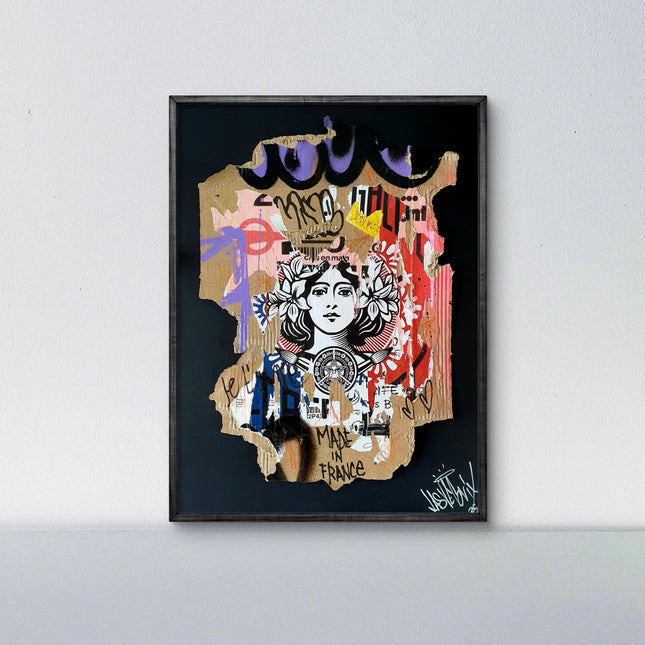
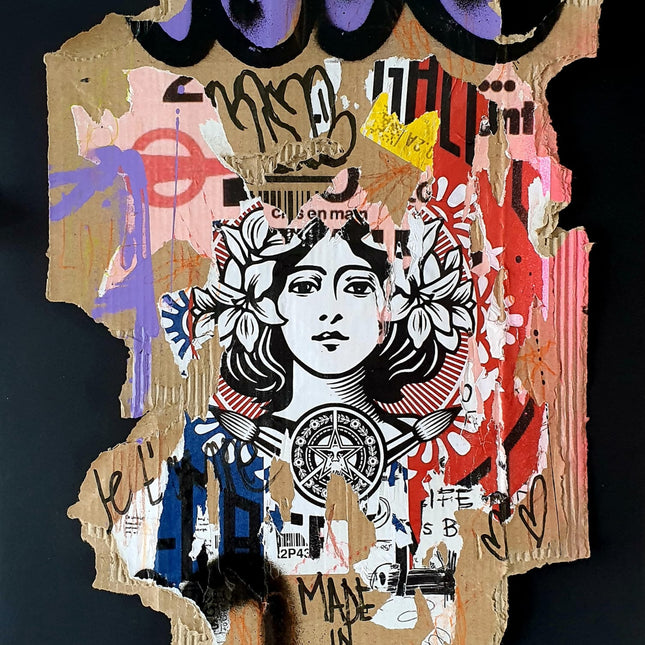
Lasveguix Marianne Obey Urban Wall Fragment #3
In this work, Lasveguix pays homage to Obey , an emblematic figure of global street art, by revisiting the iconic Marianne through his own aesthetic. On a piece of torn cardboard, with edges burned by time, the artist recreates the illusion of a fragment torn from an urban wall —a witness to a passage, a visual cry, a street memory. Layers of overlapping posters, graffiti marks, and paint chips blend chaos and harmony. The partially revealed face of Liberty emerges from the collage as a timeless symbol, both fragile and indestructible. The handwritten “Made in France” label acts as a clear signature: that of an artist who celebrates the French urban scene while engaging in dialogue with its international influences. Through Fragment of Freedom , Lasveguix questions the notion of trace and heritage. Each tear becomes the mark of a gesture, each piece of cardboard, a piece of wall that tells the story of freedom of expression. Framed size: 42 x 32 x 3 cm
€300,00
-
![Marianne Obey Urban Wall Fragment #1]()
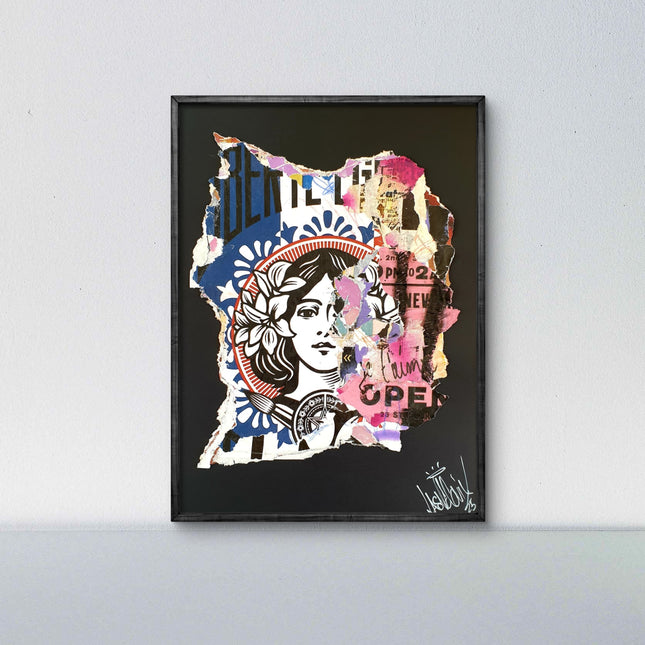
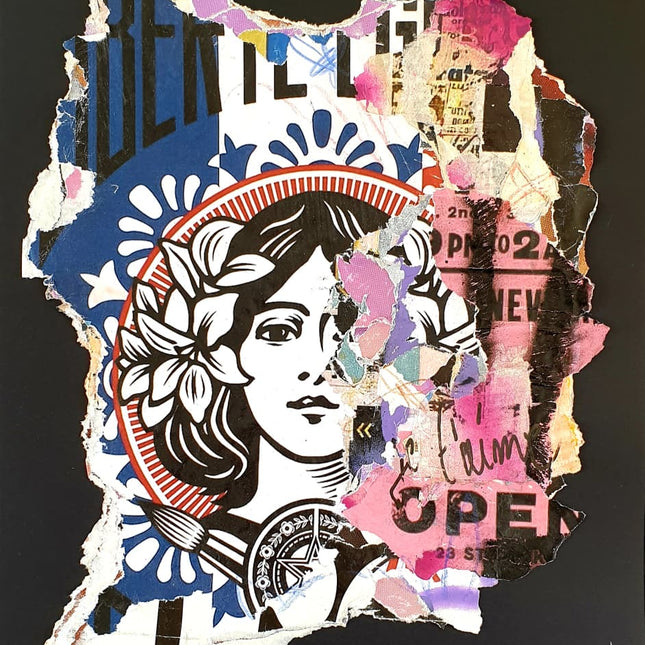
Lasveguix Marianne Obey Urban Wall Fragment #1
In this work, Lasveguix explores the technique of collage and torn posters to revisit a well-known graphic icon: the Marianne popularized by Shepard Fairey (Obey) . At the center, the stylized and ornamented face emerges through layers of colorful, typographic and handwritten posters, creating a game of progressive unveiling. The composition gives the impression of a fragment torn from an urban wall , like a section of visual palimpsest where successive layers of display tell a collective story. By mixing the visual universe of Obey — a symbol of resistance and counterculture — with his own visual language, Lasveguix composes a piece that is both raw and poetic. The tears, overlays, and textures echo the materiality of the street, where images crumble and reinvent themselves over time. The work thus questions the tension between icon and contemporary appropriation, between shared memory and personal expression. Framed size: 42 x 32 x 3 cm
€300,00
-
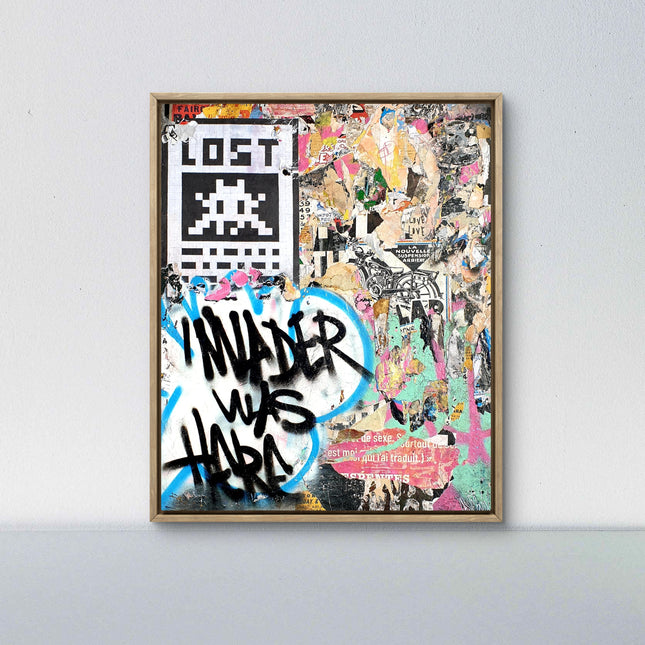
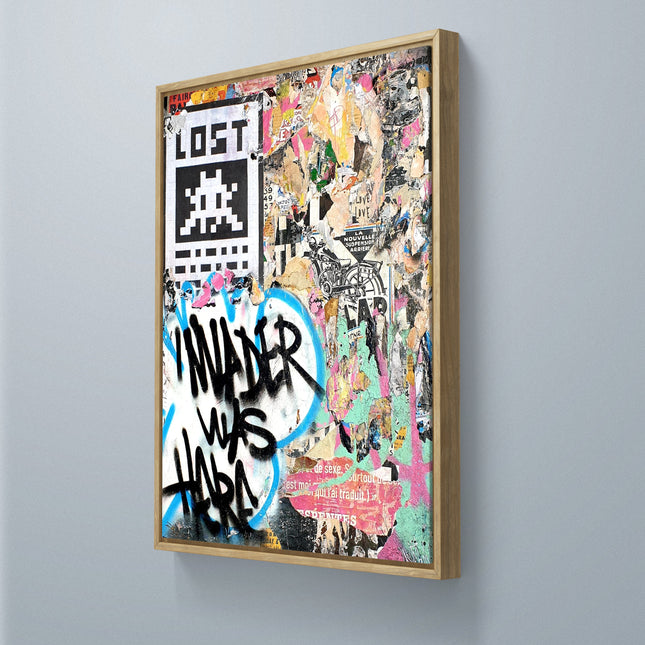
![Lost Invader]()
Lasveguix Lost Invader
This work of Lasveguix embraces a raw urban aesthetic, somewhere between collage, repurposing, and graffiti. The background is made up of successive layers of torn-off posters, typographic fragments, and advertising images reminiscent of the city's saturated walls, bearers of overlapping visual memories. In the center, a black and white visual takes up the iconography of the famous video game Space Invaders , accompanied by the word "LOST", reinforcing the idea of disappearance or wandering in the urban visual chaos. Above, a graffiti in thick and spontaneous black letters announces "INVADER WAS HERE", a direct nod to the street artist Invader and his practice of marking territory with his mosaics. A blue halo in the background highlights the inscription, as if to give it a particular aura, while the torn colors and textures of the posters contribute to the palimpsest effect. The work questions traces, memory, and ephemerality in public spaces: what is glued, covered, scratched, and then reappropriated. It creates tension between popular culture (video games, street art) and the poetic decomposition of city walls.
€1.400,00
-
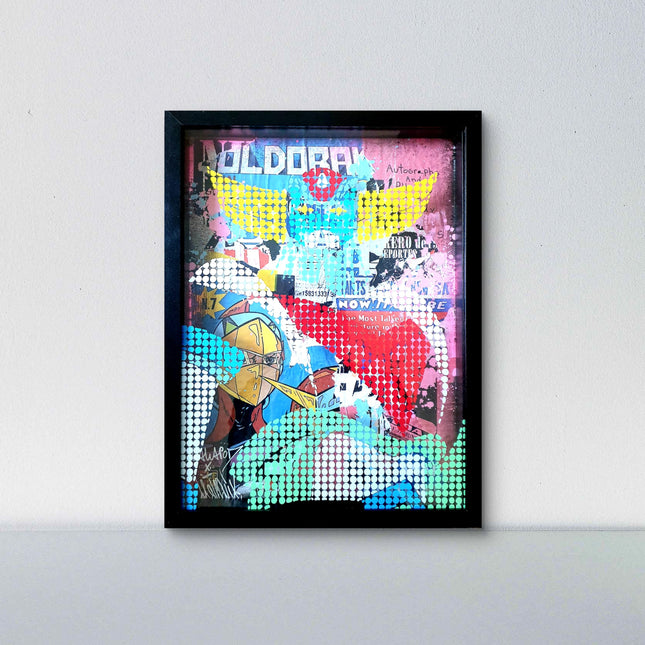
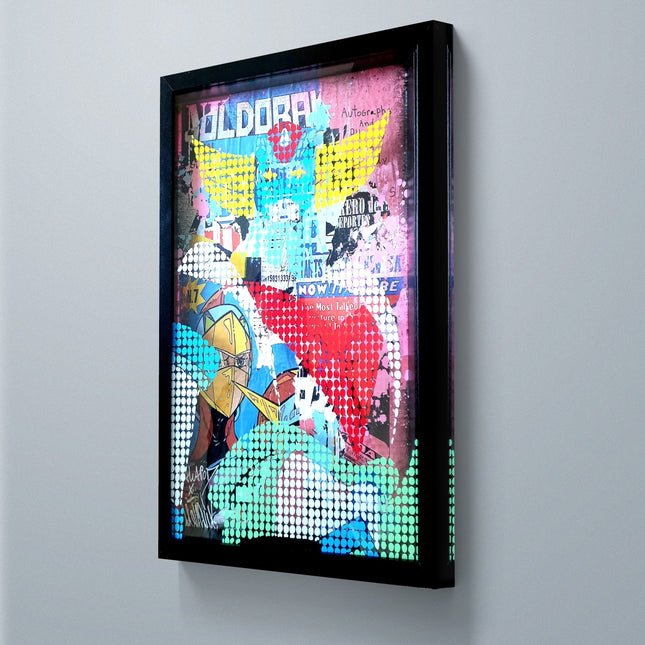
![Goldorak 1 Box 3D]()
Wawapod Goldorak 1 Box 3D
This work is born from the meeting of two complementary universes. In the background, Lasveguix creates a vibrant urban fresco: torn posters, fragments of typography, pop culture heroes and torn materials form a raw mosaic, like the walls of a city saturated with collective memory and popular imagination. Among these layers, we can guess the mythical figure of Goldorak , an intergenerational icon, emerging like a heroic totem in the midst of chaos. On the glass that protects the collage, Wawapod intervenes with its characteristic visual language: a grid of colored dots, almost pixelated, which acts as an optical filter and a contemporary reinterpretation. This graphic veil transforms the perception of the work, blurring it and revealing it at the same time, recalling the codes of both digital and screen printing. By combining their gestures, the two artists offer a dual interpretation: Lasveguix's nostalgic and urban memory interacts with Wawapod's rhythmic pop abstraction. The whole becomes a hybrid work, both a tribute to childhood and an aesthetic exploration of the contemporary gaze.
€650,00
-
![Urban Joconde]()
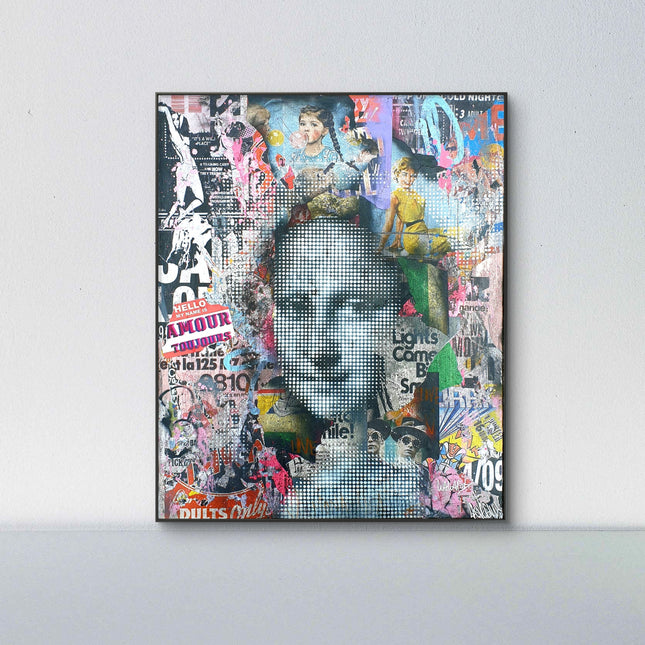
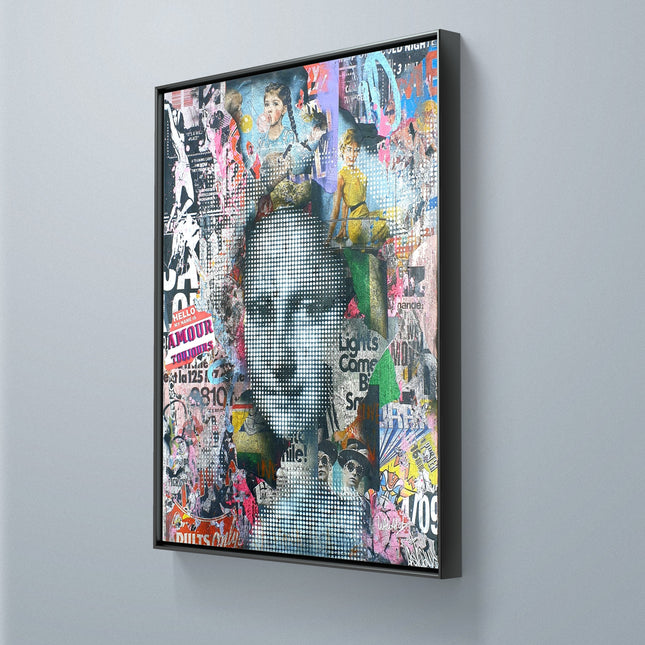
Wawapod Urban Joconde
At the heart of this abundant composition, the Mona Lisa stands out, revisited with the contemporary audacity characteristic of Wawapod . Reinterpreted as a constellation of white dots on a black background, it floats in the center of the canvas like a pixelated apparition, both recognizable and abstract. Its gaze, enigmatic as always, slips into the visual tumult orchestrated by Lasveguix , whose colorful and saturated collages evoke the raw energy of the city walls. Around the Mona Lisa, fragments of popular culture collide: a little girl blowing a bubble of gum, female icons from vintage magazines, typography ripped from the street, hip-hop figures, and fragments of comics. This carefully composed urban chaos powerfully highlights the serenity of the central face. The sticker “ Hello, my name is Amour Toujours, ” Wawapod’s leitmotif, punctuates the work like a declaration of tenderness addressed to Leonardo da Vinci’s icon—and, through her, to the entire history of art. Here, the Mona Lisa is no longer frozen in a museum: she lives, breathes, and evolves in a world of color, noise, and contradictory messages. She becomes a figure of gentle resistance in our image-saturated era.
€1.450,00
-
![Wild love]()
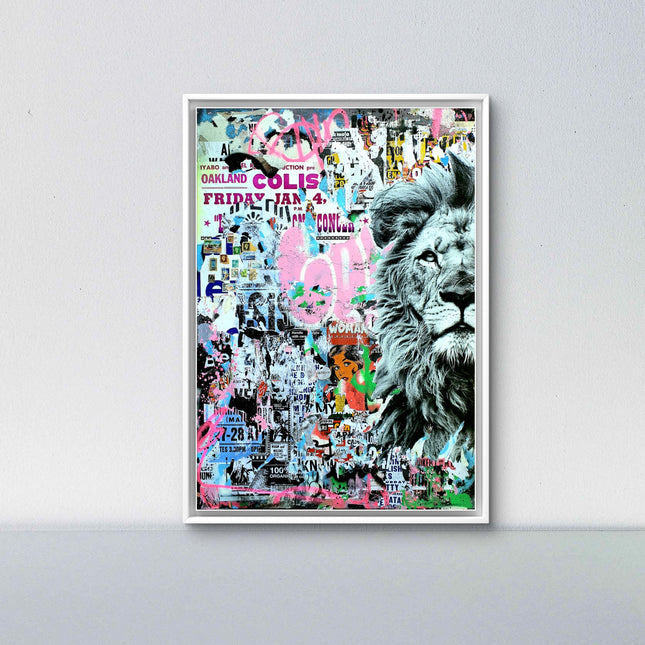
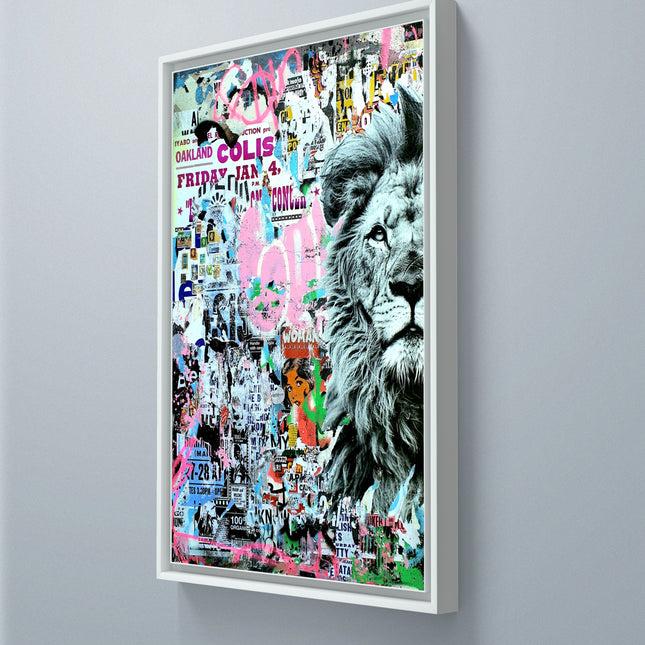
Lasveguix Wild love
In "Wild Love" , Lasveguix fuses the raw instinct of nature with the urban energy of contemporary street art. This abundant work juxtaposes the majestic, hyperrealistic image of a lion, a symbol of strength and pride, with a chaotic collage of advertisements, graffiti, and torn vintage posters, witnesses to a collective urban memory. The word "YES," painted in bright pink in the center of the canvas, contrasts with the feline's wildness and evokes a surge of acceptance, hope, or raw passion. We also glimpse an illustrated woman, in pop art style, who seems to be looking intensely at the viewer—a nostalgic yet powerful reminder of the female figure in the popular imagination. Here, Lasveguix explores the duality between love and instinct , the civilized and the wild, past and present. The splattered layers of paint, the superimposed typography, and the torn elements give the work an almost musical rhythm, somewhere between tension and harmony. "Amour Sauvage" is a visual statement where tenderness meets power, and where street art becomes the language of primal emotions, expressed with striking intensity.
€1.500,00
-
![Arc de Triomphe - Paris]()
Giorgio Stocco Arc de Triomphe - Paris
In this striking work, Giorgio Stocco reinterprets the iconic Arc de Triomphe , placing it at the heart of a reinvented urban scene, on the border between realism and fantasy. Created digitally and then pasted onto canvas , the composition offers a contemporary interpretation of the Parisian monument , transformed here into a vertical playground. The Arc comes to life: dozens of figures—tiny but animated— climb its facades , cling to its sculptures, wander across the upper terrace, or shelter under a floating tricolor umbrella . The work introduces a fascinating play of scale , between architectural monumentality and human abundance. The background, discreet but present, is composed of printed pages , adding a cultural and textual texture that enriches the reading of the piece. With this offbeat scene, Giorgio Stocco questions the relationship between man and history , between the individual and symbols. He mixes humor, visual poetry and a remarkable technical mastery of digital imagery, served by a collage perfectly integrated into the canvas support , halfway between traditional painting and contemporary digital art.
€450,00
-
![Jean-Michel Basquiat]()
Lasveguix Jean-Michel Basquiat
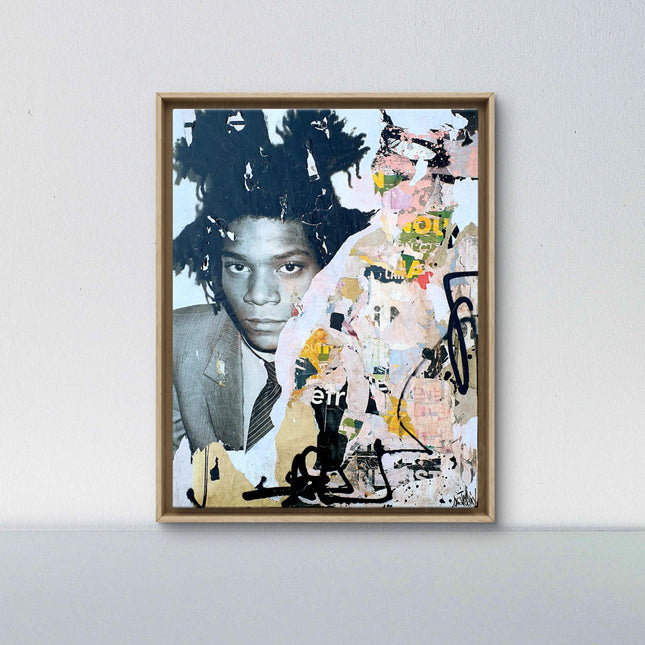
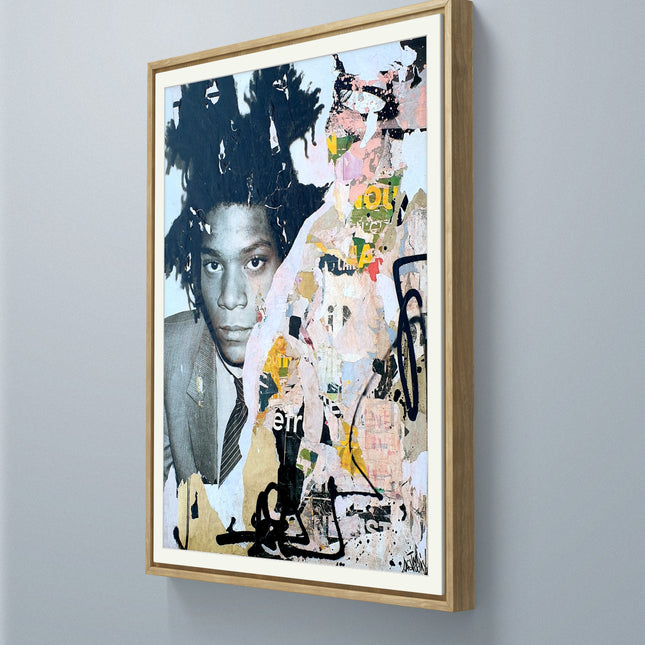
In this powerful work, Lasveguix pays homage to Jean-Michel Basquiat, an iconic figure in urban art and African-American culture. Basquiat's black and white face, dressed in a sober suit and tie, contrasts with the chaotic explosion of torn paper, layers of torn posters, colors, and graffiti surrounding him. The classic portrait is literally invaded by a living urban material, highlighting the tension between the frozen icon and the raw energy of the street. Lasveguix's approach consists of deconstructing the image in order to better recontextualize it, in a visual language made of superimposed layers, textures, and half-erased typography. We can distinguish fragments of words ("err," "live," "you"), bursts of pink, yellow, and black paint, as well as splashes that recall the spontaneous gesture of street art. The result is a portrait that is both reverential and organic, in which Basquiat's identity emerges through the visual tumult as a persistent, rebellious, and mythical presence.
€1.100,00